

Artificial intelligence (AI) is everywhere. It suggests what shows we should binge, finishes our text messages, and even helps doctors read medical scans. But what happens when AI shows up in something as personal and life-changing as your injury claim?
Many conversations about AI and the law focus on whether or not lawyers will soon be replaced by machines. At this point, AI can’t litigate a case in court, so that’s not the real question claimants should ask. The bigger issue is whether AI could quietly change how your claim is evaluated, negotiated, and even decided.
This post explores how AI might not just alter how lawyers practice law, but how it could directly affect the outcome of your personal injury claim—for better or worse.
Where AI Already Shows Up in Personal Injury Claims
You may not realize it, but AI is already baked into parts of the claims process:
- Insurance companies: Many insurers use AI algorithms to predict settlement ranges, evaluate damages, and identify “high-risk” claims.
- Medical care: Hospitals and clinics use AI to detect fractures, brain injuries, and other conditions on imaging scans. These records often become evidence in personal injury cases.
- Accident reconstruction: Traffic cameras, vehicle black box data, and even smart streetlights may be analyzed with AI tools to determine fault.
- Claims portals and apps: If you submit information through an online claims form or chatbot, you may already be dealing with an AI system instead of a human.
On the surface, these tools look efficient. But efficiency can come at a cost—especially if an algorithm becomes the silent decision-maker in your case.
The Hidden Risks: When AI Becomes the “Silent Adjuster”
One of the most concerning possibilities is that AI could act as an invisible adjuster—silently influencing the value of your claim without you ever knowing.
Examples of how this can happen include:
- Bias in training data: If an AI-driven algorithm learns from years of past settlements, it may reproduce unfair patterns—like consistently undervaluing claims from certain communities.
- Lack of opacity: Unlike a human adjuster, AI doesn’t explain why it flagged a claim as “low value.”
- Speed over scrutiny: It can also skip over details a human would notice. AI does not have emotions, and it does not understand nuance. Faster is not always better, or accurate.
AI can undervalue claims quietly, making it harder for victims to realize why their case isn’t being taken seriously.

6 Common “Silent Adjuster” Impacts
Here are some ways the “silent adjuster” might already be at work and impacting personal injury cases:
- Medical Records Summarized by AI: Instead of reading every note, AI may condense your medical history. If it misses a doctor’s observation about ongoing pain or disability, the summary could make your injury appear less serious.
- Claimant Red-Flagged by Zip Code or Occupation: Algorithms may categorize claimants from certain neighborhoods or job types as “more likely to exaggerate.” That label could reduce the value of your claim before anyone hears your story.
- Wearable Tech Misinterpretation: Fitness trackers and smartwatches can provide data about movement. But if your Fitbit records one long walk on a “good day,” AI might ignore the many days when you couldn’t get out of bed.
- Inconsistent Social Media Presence: Posting photos of vacations, exercise, or smiling at a family event could be flagged as inconsistent with reported pain levels.
- Automated Credibility Scoring: Language-processing tools may analyze your statements for “inconsistencies.” Minor differences between interviews could wrongly be labeled as dishonesty.
- Settlement Bracketing: AI may place your injury into a payout range based on historical averages. That means your unique circumstances, like a career cut short or loss of independence, aren’t given full weight.
The Double-Edged Sword of AI Evidence
AI doesn’t just evaluate claims; it can also generate evidence.
- On the positive side: An AI-assisted medical scan might detect subtle injuries a doctor could miss, strengthening your case. Accident reconstruction tools could create detailed timelines that prove fault.
- On the negative side: Opposing counsel might challenge whether AI evidence is reliable or admissible. If the basis for how an algorithm evaluates data can’t be explained, a judge may discount it.
There are also ownership and chain-of-custody questions. If an AI tool creates an accident reconstruction, who owns the output? And how do we know the software wasn’t biased or manipulated?
Imagine this: a spinal injury that doesn’t show up on a traditional MRI is flagged by an AI system. That evidence could be game-changing for your claim. But if the defense argues the technology isn’t trustworthy, the very evidence that should help you could end up in dispute.
AI evidence is powerful—but only if your legal team is prepared to authenticate it and argue for its weight in court.
Human vs. Machine in Settlement Negotiations
Settlement negotiations are already changing, too. Insurers are adopting predictive settlement tools that calculate how much a case is “worth” and how likely a claimant is to accept a certain offer. That data is then used to guide negotiations.
The risk is clear: an injured person negotiating alone could be up against an algorithm designed to lowball them. Imagine receiving an offer through a chatbot that says, “This is the best we can do.” Without context, you might believe it. And if you accept that offer and then pursue a more fair settlement with a lawyer later, it will likely be too late.
Attorneys, on the other hand, can push back before the offer is accepted. They can argue that no two claims are identical and highlight the human factors AI leaves out, such as emotional trauma, career changes, or the daily impact of pain.
Negotiation has always been part science, part art. The science may shift to AI, but the art still belongs to humans.

Practical Steps Claimants and Lawyers Should Take
If AI is already influencing claims, what can you do?
- Ask questions: Was AI used to evaluate your claim? If so, how?
- Double-check medical AI results: Always confirm AI-detected findings with a human medical expert.
- Preserve your personal record: Write down pain levels, limitations, and setbacks to support what AI or wearables might miss.
- Prepare AI evidence for court: Work with attorneys who can challenge or authenticate AI-generated reports.
The best defense against an invisible adjuster is visibility. The more you understand where AI shows up, the better you can protect your claim.
Will AI Help or Harm Claimants?
AI is a tool, and like any tool, whether it’s helpful or harmful depends on how it’s used.
For injured people, AI could mean stronger medical evidence, faster claim processing, and fairer settlements. But it could also mean hidden bias, undervalued claims, and a system that ignores the fact that every case represents a human story.
At the end of the day, personal injury claims aren’t just about data points. They’re about people and the lives changed by injury, the families affected, and the futures put on hold.
AI might shape the process, but ensuring justice occurs requires something no machine can provide: human advocacy, empathy, and the determination to make your story heard.
AI Can’t Effectively Document Your Accident In Real Time
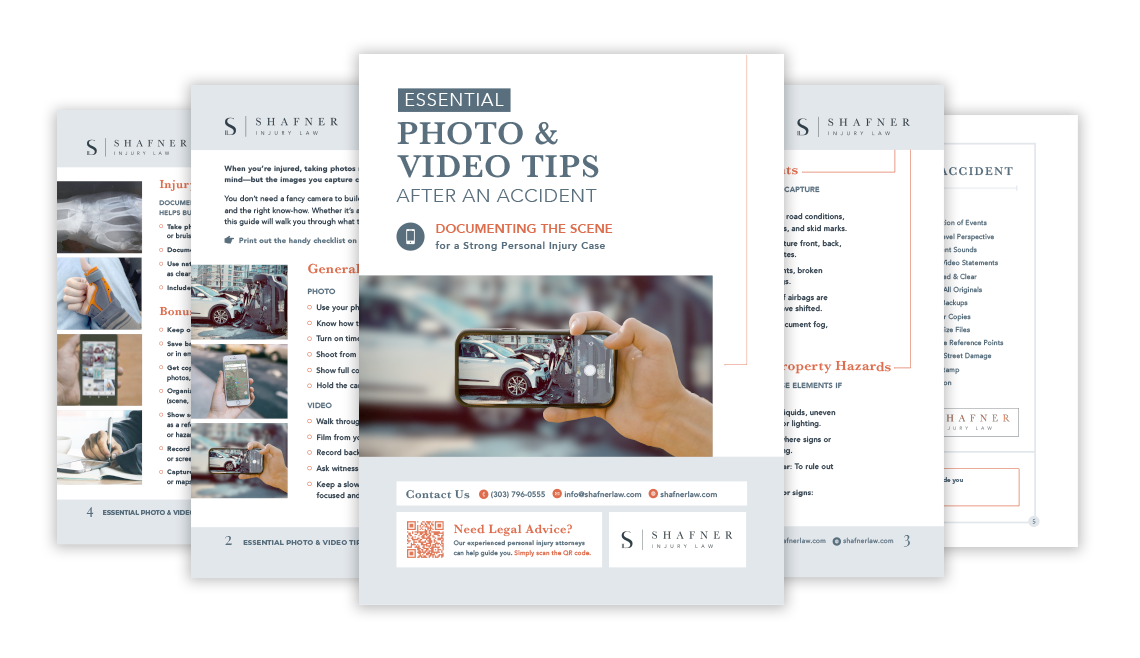
Essential Photo & Video Tips After an Accident
This free resource is filled with helpful tips for recording the scene and any injuries with your phone. Learn what to capture with photos and videos so you’re prepared to help build a successful legal case—and you can print out the checklist to keep in your glove box so you don’t miss anything important.
Contact Us Today for Help Navigating AI
If you or a loved one has been injured in Colorado or Wyoming, Shafner Injury Law is here to help. We’ll listen with care and without judgment and fight for your fair and just compensation. Let us do the heavy lifting so you can focus on healing and getting your life back on track.
Over the last year, we have handled cases for clients who tried to settle their personal injury cases by themselves using AI. What we have found repeatedly is that AI-generated materials are often inaccurate, leave important details out, and create more problems for the case.
Let our experienced, results-driven accident attorneys handle the complicated web of insurance claims and take your case to trial if necessary. And remember, we work on a contingency fee basis: we only get paid when you get paid.