

A Confusing Mix of Traffic Laws, Liability Issues and Insurance Gaps
When a crash happens on an e-bike or electric scooter, victims face a confusing mix of traffic laws, product liability issues, and insurance gaps that didn’t exist a decade ago. The legal team at Shafner Injury Law has successfully represented clients injured on electric scooters and e-bikes, and we know how to navigate this rapidly evolving legal landscape.

Why E-Bike & E-Scooter Accidents Are Legally Complex
Traditional bicycle accident law is well-established, while electric vehicle law is new and developing. E-bikes can reach speeds of 28 mph or more, and shared scooters (rental/fleet models that you unlock with a phone app and credit card) operate in legal gray zones between the sidewalk and the street. The three-class classification system for e-bikes governs where these vehicles are allowed and what rules apply—and getting that classification wrong can impact your claim.
These cases can involve multiple responsible parties:
- Distracted drivers
- Municipalities with poorly designed bike lanes
- Scooter-share companies with inadequate maintenance practices
- Manufacturers who sold a defective product
You need an attorney who understands all of these angles.
Colorado E-Bike & E-Scooter Laws
Three-Class E-Bike System
If you’re in a Class 3 e-bike accident in Colorado, it’s important to understand the state’s formal system under C.R.S. § 42-1-102:
- Class 1: Pedal-assist only, motor cuts off at 20 mph. Treated like a standard bicycle for most purposes, with broad trail access.
- Class 2: Throttle-assisted, motor cuts off at 20 mph. Generally treated like a bicycle, but some trails restrict throttle-assist bikes.
- Class 3: Pedal-assist, motor cuts off at 28 mph. Riders must be at least 16 years old and are required to wear a helmet.
Electric Scooter Rules In Colorado
In 2023, Colorado legalized electric scooters statewide under C.R.S. § 42-4-109.5.
Key provisions include:
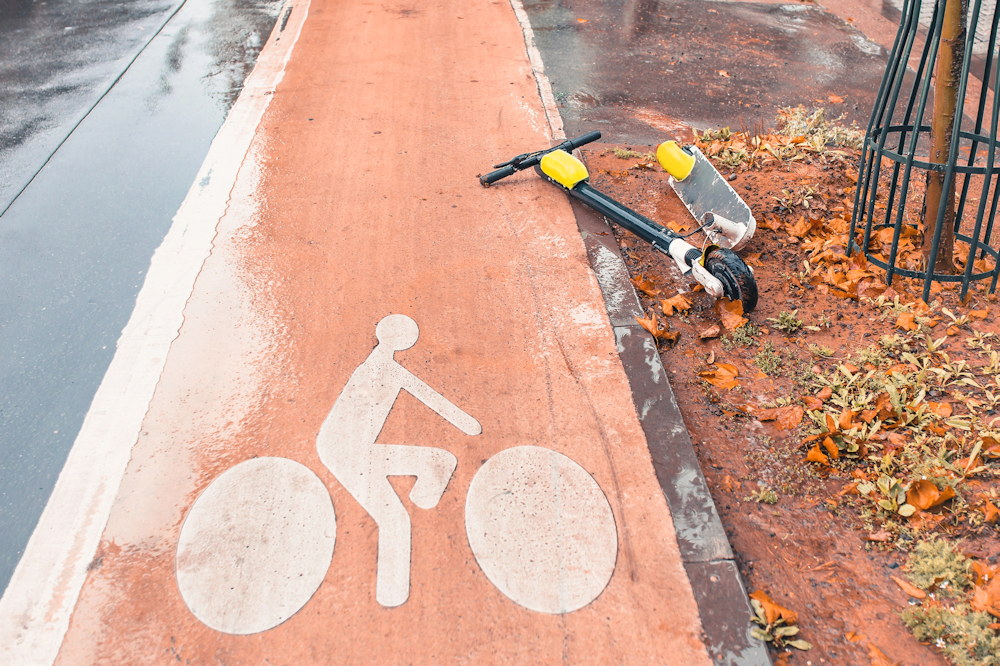
- E-scooters are limited to 20 mph and may be ridden in bike lanes
- Riders must be at least 16
- Helmet use is encouraged but not required for adults in most jurisdictions;
If you have a dockless scooter injury claim, it’s important to know that Denver’s program requires companies to carry liability insurance, which can be a direct source of recovery after an accident. Dockless scooters are picked up and dropped off by riders anywhere within a designated city zone.
Trail And Path Access
E-bikes are generally allowed in Colorado State Parks that permit mountain biking, and on federal lands, they’re typically restricted to motorized trails unless local rules say otherwise. On paved bike/pedestrian paths, the electric-assist feature is generally prohibited statewide, with local exceptions in Boulder, Breckenridge, Superior, and Vail.
Comparative Fault & Deadlines
Colorado follows modified comparative negligence (C.R.S. § 13-21-111): if you are 50% at fault, you will recover $0.
The general statute of limitations for personal injury is three years. Claims against government entities are subject to special notice requirements and shorter internal deadlines.
Wyoming E-Bike & E-Scooter Laws
Wyoming’s E-Bike Classification
Wyoming adopted a three-class e-bike system under Wyo. Stat. § 31-5-102. E-bikes under 750 watts are not classified as motor vehicles and require no registration, insurance, or license. Because there is no mandatory e-bike insurance in Wyoming, coverage gaps are common, and injured riders may need to pursue the at-fault driver’s insurance, their own UM/UIM coverage, or a products liability claim.
Electric Scooters In Wyoming
Wyoming’s statewide e-scooter law is less developed than Colorado’s. Communities, including Cheyenne and Jackson, address scooters through local ordinances. Because the statutory framework is thin, establishing liability after a Wyoming e-scooter accident typically requires a more intensive investigation of local rules, company operating agreements, and available insurance.
Wyoming Comparative Fault — A Critical Difference
Wyoming uses modified comparative negligence under Wyo. Stat. § 1-1-109, but with a stricter threshold than Colorado: your fault must be less than 50%, not merely 50% or less. If a jury finds you exactly 50% at fault in Wyoming, you recover nothing. This makes the fight over liability allocation particularly high-stakes, and it is one of the most important reasons to have experienced legal representation from the outset.
Wyoming’s statute of limitations for personal injury is four years and claims against government entities require a written notice of claim within two years.
Common Causes of E-Bike & E-Scooter Accidents
- Drivers failing to yield at intersections or crosswalks
- Dooring accidents: A parked driver opens a door into the rider’s path
- Left-cross collisions: A turning vehicle fails to see an oncoming rider
- Distracted driving: Texting, phone use, or general inattention
- Road hazards: Potholes, uneven pavement, drain grates, or missing signage
- Defective equipment: Brake failures, battery fires, structural design defects (product liability)
- Scooter-share company negligence: Renting out a fleet vehicle with known mechanical problems
- Inadequate bike lane design: Municipal planning failures that put riders in danger
What to Do After an E-Bike or E-Scooter Accident
Whether you’re in an e-bike accident on a bike path or hit by a car on an electric scooter, it’s important to follow these steps:
- Call 911 and get a police report, even if the accident seems minor.
- Photograph the scene, the vehicle that struck you, your bike or scooter, road conditions, and all visible injuries.
- Collect witness information.
- Do not give a recorded statement to any insurer before speaking with an attorney.
- Preserve your e-bike or scooter; do not repair it, as it may be critical evidence.
- Seek medical attention promptly, even if you feel okay.
- Contact a lawyer as soon as possible; traffic camera footage and cell phone data can disappear within days.
Note: Insurers begin building their defense immediately after an accident. Their goal is to minimize your payout. Our goal is the opposite. At Shafner Injury Law, we work on a contingency fee basis—you pay nothing unless we recover compensation for you.
What Compensation Can You Recover?
You may be able to recover medical expenses (past and future), lost wages and diminished earning capacity, pain and suffering, permanent disability or disfigurement, property damage to your e-bike or scooter, and wrongful death damages.
In cases involving particularly reckless conduct, such as a drunk driver or a company that knowingly ignored safety defects, punitive damages may also be available in Colorado and, under limited circumstances involving willful and wanton misconduct, in Wyoming.
Frequently Asked Questions
Do I need a driver’s license to ride an e-bike or e-scooter in Colorado or Wyoming?
No, but this also means no mandatory insurance protects you as a rider. Pursuing the at-fault party’s coverage or your own UM/UIM policy becomes essential after a serious accident.
Can I sue a scooter-share company like Bird or Lime?
Possibly. User agreement waivers are not always enforceable—especially in cases involving negligent maintenance or defective equipment. An attorney can evaluate your specific circumstances.
What if the driver who hit me fled the scene?
Your own auto policy’s uninsured motorist coverage may apply even though you were on a bike. We have experience pursuing hit-and-run claims and locating all available sources of recovery.
Can I still recover if I wasn’t wearing a helmet?
In most cases, yes, although insurers will attempt to use this to reduce your recovery. Only Class 3 e-bike riders are legally required to wear helmets in Colorado. We can counter comparative fault arguments designed to undervalue your claim.
How long do I have to file?
Three years in Colorado, four years in Wyoming, for personal injury. Government entity claims may require action in as little as six months. Do not wait to find professional legal help to help you file a claim.
How Shafner Injury Law Can Help
We have successfully obtained compensation for clients struck while riding electric bicycles and scooters, and we understand the unique challenges these cases present: from disputed liability and coverage gaps to municipal defendants and product liability claims. We’re here to handle the legal complexity so you can focus on your healing and recovery.
- Contact us today for a free consultation.
Additional Auto Accident Resources
What to Do After a Car Accident with an Uninsured Motorist – Colorado & Wyoming Guide
Being involved in a car accident is stressful on its own, but when the other driver is uninsured, it can be even more overwhelming. Knowing the steps to take immediately after an [...]
What Every Truck Accident Victim in Colorado and Wyoming Should Know
Truck accidents can turn life upside down in an instant, and dealing with what comes next isn’t always straightforward. With so many moving parts, from insurance issues to liability questions, it’s easy [...]

Understanding TBI (Traumatic Brain Injury)
TBI (Traumatic Brain Injury) is a term frequently found in the medical records of car accident victims, but its meaning is often misunderstood. Confusion stems from the broad definition of the term, [...]
Collision May Be Likelier On These Wyoming Roads
There are numerous reasons why many people love living in or visiting Wyoming. Driving on state roadways is probably not one of them, however. This state ranks high on lists for most [...]
Wyoming Collision Numbers Soar During Summer
Summer is here, Wyoming schools are out, and lots of people are taking time off work to vacation with their families and friends. From backyard cookouts to week-long beach trips, it’s a [...]
What is Med Pay?
Med Pay, or Medical Payment coverage, is a type of insurance that is designed to provide fast payment of medical bills in the event of an accident. It is a hybrid kind [...]
