

What to Do Immediately After a Car Accident
The decisions you make and actions you take in the first hour after a crash can impact what happens many months later. Here’s what matters most:
Make sure everyone is safe.
If no one is injured, move vehicles safely to the side of the road if possible.
Call 911.
A police report is one of the most important pieces of evidence in your case, even if the accident is minor. A report documents the scene, establishes an official record, and in Colorado, designates an at-fault driver. Note: If police don’t respond to a minor crash in Colorado, the law requires drivers to file their own accident report.
Exchange information and document everything.
Get the other driver’s name, license, registration, and insurance information. Photograph the vehicles, the scene, skid marks, road conditions, traffic signals, and any visible injuries.
See a doctor.
Even if you feel fine, adrenaline can sometimes mask injuries. Traumatic brain injuries, herniated discs, and internal injuries can all present with delayed symptoms. A gap between your accident and your first medical appointment is one of the first things insurers look for when building an argument to minimize your claim.
Don’t give recorded statements.
You’ll likely hear from an insurance adjuster quickly. You are not required to give a recorded statement to the other driver’s insurer, and doing so before you’ve spoken with an attorney can seriously harm your case. It’s completely appropriate to say your attorney will be in touch.
Our blog post What Happens After You File a Car Accident Claim in Colorado? Provides a deeper dive into what you can do to support the best outcome in your case.

Who Is at Fault in a Car Accident?
Both Colorado and Wyoming are at-fault states, where the driver who caused the accident—or more precisely, their insurance company—is responsible for paying damages. However, as many of our clients have learned, fault isn’t always cut and dry, and how it’s determined differs slightly between the two states.
Colorado accident police reports always designate an at-fault driver. The legal standard is negligence: if the driver failed to exercise reasonable care. Colorado follows a modified comparative negligence rule with a 50% bar. This means that if you’re found less than 50% at fault, you can still recover, but your damages are reduced proportionally by your percentage of fault. At 50% or more, you cannot recover anything.
Wyoming uses a similar framework with one meaningful difference: a 51% bar. A party found 51% or more at fault cannot recover. Below that threshold, damages are reduced proportionally by your percentage of fault.
In both states, the percentage of fault is typically determined through a combination of the police report, witness statements, physical evidence, and in some cases accident reconstruction analysis. Insurance companies investigate fault aggressively because shifting even a small percentage of responsibility to you reduces what they have to pay, which is one reason having an attorney who conducts an independent investigation matters so much.
Learn more about how Shafner Injury Law can help with your general negligence case.

What Damages Can You Recover?
Car accident victims in Colorado and Wyoming can recover two broad categories of damages:
Economic damages — the concrete, documentable financial losses:
- Medical bills, past and future
- Lost wages and lost earning capacity
- Property damage
- Out-of-pocket costs (prescriptions, transportation to appointments, medical equipment)
Non-economic damages — the harder-to-quantify human losses:
- Pain and suffering
- Emotional distress
- Disfigurement
- Loss of enjoyment of life
- Loss of consortium — compensation for a spouse or family member who loses the support and companionship of an injured loved one
One important distinction between the two states: Colorado caps non-economic damages in most personal injury cases at $642,180 (adjusted periodically for inflation), with limited exceptions for cases involving extraordinary circumstances. Wyoming imposes no statutory cap on non-economic damages, which can be a meaningful advantage in serious injury cases filed there.
Punitive damages are available in both states when a defendant’s conduct is found to be willful and wanton, such as drunk driving. In Colorado, punitive damages are generally not covered by the at-fault driver’s insurance policy, which means the driver is personally responsible, creating real strategic leverage in settlement negotiations.
Our results for motor vehicle crash victims show what’s possible when cases are built with care and aggressively negotiated: $4 million in a truck accident settlement, $1 million in a rear-end crash, $800,000 in a head-on collision, and more.

Insurance Requirements
Understanding what coverage exists and where the gaps are is critical to evaluating a claim.
Colorado minimum required coverage:
- $25,000 per person / $50,000 per accident bodily injury liability
- $15,000 property damage
- Approximately 13% of Colorado drivers carry no insurance at all
Wyoming minimum required coverage:
- $25,000 per person / $50,000 per accident bodily injury liability
- $20,000 property damage
- Wyoming requires insurers to offer uninsured/underinsured motorist (UM/UIM) coverage to every driver, and drivers can waive UM/UIM coverage in writing
Med Pay: Available in both states and typically $5,000 on a standard auto policy, Med Pay provides quick reimbursement for medical bills without first establishing fault. In Colorado, you don’t have to reimburse Med Pay funds from your settlement, making it one of the most underused and valuable coverages available.
Uninsured/Underinsured Motorist (UM/UIM) coverage is the single most important optional coverage you can carry. If the driver who hits you has no insurance or insufficient coverage, UM/UIM is the only thing standing between you and an uncovered loss. We recommend every driver in Colorado and Wyoming carry it.

Common Car Accident Injuries
Car accidents produce a wide spectrum of injuries, from soft tissue strains to catastrophic, life-altering trauma.
The most common include:
Whiplash and soft tissue injuries
These tend to be the most frequently disputed injuries in car accident claims. Insurers routinely argue that soft tissue damage isn’t serious or isn’t accident-related. Strong medical documentation and, in some cases, biomechanical evidence (expert analysis of how crash force affects the human body) are essential to winning these claims.
Traumatic brain injury (TBI)
Ranging from mild concussion to severe, permanent cognitive impairment. TBI is frequently underdiagnosed immediately after an accident because symptoms develop over time.
Herniated discs and spinal injuries
Among the most painful and debilitating in a car accident, spinal cord injuries often require surgery and long-term rehabilitation.
Broken bones
Arms, wrists, ribs, and hips are most common. Fractures that require surgery significantly increase the value of a claim.
Internal injuries
Organ damage and internal bleeding can be life-threatening and may not be apparent at the scene.
Post-traumatic stress disorder (PTSD)
A legitimate and compensable injury that is frequently overlooked in car accident claims.
A note on delayed symptoms
If you feel fine immediately after a crash, don’t assume you are. Many of the injuries above—TBI and internal injuries especially—don’t reveal themselves in the first hours. See a doctor the same day, describe everything that feels even slightly off, and follow up if new symptoms develop.
How the Settlement Process Works
Most car accident cases in Colorado and Wyoming settle before trial. But the path from crash to receiving your check is longer and more involved than most people expect.
Investigation comes first; gathering the police report, medical records, witness statements, and vehicle damage documentation. In complex cases, your legal team will need to obtain accident reconstruction records and electronic vehicle data. Evidence disappears quickly, so an attorney should begin this process immediately.
Maximum Medical Improvement (MMI) is the milestone your case must reach before it can be properly valued and settled. Your attorney cannot negotiate a final number until the full extent of your injuries is known; otherwise you risk settling before future surgery, long-term care costs, or lost earning capacity are accounted for.
The demand letter formally opens negotiation. It lays out the facts, establishes fault, documents damages, and states the compensation you’re seeking. The insurer responds, and there’s typically some back-and-forth before both sides reach an agreement.
Statutes of limitations — the deadlines you cannot miss:
- Colorado personal injury: 3 years from the date of the accident
- Wyoming personal injury: 4 years from the date of injury
- Wrongful death (both states): 2 years
- Claims against government entities: shorter deadlines apply; contact an attorney immediately if a road defect, government vehicle, or municipality is involved

Should I Get a Lawyer for a Car Accident?
Studies, including those funded by the insurance industry itself, have consistently found that victims who retain a lawyer receive settlements that are double or more than those without a lawyer. That gap more than covers legal fees in most cases.
If you’re in a car accident, you should call an attorney if:
- Anyone was seriously injured
- Fault is being disputed
- You’ve missed work or face long-term medical treatment
- The insurance company is pressuring you for a recorded statement or quick settlement
- The at-fault driver was uninsured or underinsured
- A commercial vehicle (truck, rideshare, or bus) was involved
- The accident happened in a construction zone or involved a road defect
At Shafner Injury Law, consultations are always free, and we only collect a fee when we win.

Free Download
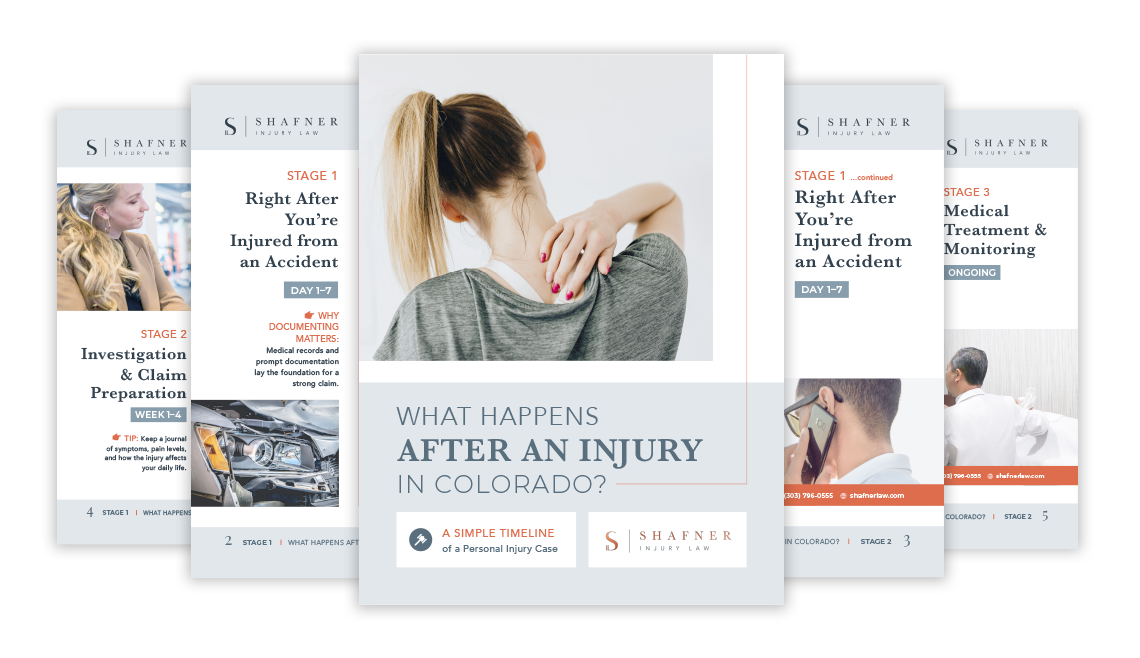
What Happens After an Injury?
If you’ve been in an accident, the amount of information coming at you and details you need to keep track of can be overwhelming: insurance calls, medical bills, accident reports, and questions from colleagues and family, all while you’re trying to heal.
We put together a free guide that can help you prepare for moments like this. It walks you through what to expect after an injury, in plain language, so you can feel informed and in control rather than lost in a process designed by and for insurance companies. It’s free and takes about five minutes to read.
Special Circumstances That Change the Legal Picture
Some accidents involve factors that significantly affect strategy, liability, and the amount you can recover. Here’s a brief overview of the most common, with links to content we developed for these topics:
Drunk driving accidents
Civil and criminal cases run on separate tracks. You don’t need to wait for a criminal conviction to pursue your claim. Punitive damages may apply, and in some cases a bar or restaurant that overserved the driver can also be held liable under Colorado’s dram shop law. Wyoming does not have a dram shop law. To learn more, read our blog post: Hit by a Drunk Driver in Colorado?
Distracted driving
Cell phone records and tower data can be subpoenaed. Dashcam footage and traffic cameras are increasingly important evidence in distracted driving cases.
Uninsured and underinsured drivers
Your own UM/UIM coverage is your primary protection. These claims pit you against your own insurer, making legal representation especially important.
Rideshare accidents
Uber and Lyft accidents involve multiple insurance layers that change depending on what phase of a trip the driver was in at the moment of the crash. The corporate legal teams move fast. So should you. Learn more on our blog post: Injured in an Uber or Lyft in Colorado?
Truck accidents
Federal FMCSA regulations apply, and liability in a truck accident can extend beyond the driver to the trucking company, cargo loaders, and maintenance providers. Preserve any electronic data from the vehicle immediately.
Hit-and-run accidents
Evidence preservation is urgent because traffic and doorbell camera footage disappears quickly. Cell tower data can sometimes identify a fleeing driver in a hit-and-run accident.
Wrongful death
When a car crash is fatal, the victim’s family may have the right to pursue compensation for funeral expenses, lost income, loss of companionship, and more. The deadline in both Colorado and Wyoming is two years.
Motorcycle accidents
Motorcyclists are disproportionately vulnerable in crashes with motor vehicles, and insurers are notoriously biased against riders when assigning fault.
Pedestrian accidents
A car hitting a pedestrian is still considered a car accident, and the injuries are often catastrophic. Insurers routinely argue the pedestrian jaywalked or was distracted to shift fault and reduce payout. A quick investigation of traffic cameras, crosswalk signal timing, and witness accounts is essential.

Why Hire Shafner Injury Law
We’ve been doing this for nearly 50 years. In that time, we’ve recovered millions of dollars for car accident victims across Colorado and Wyoming by fighting hard on complex cases.
Besides our experience, what sets us apart is how we work. Our clients have direct access to their attorney, and our team digs deep into every detail of your case to reach the best possible outcome. Along the way, we keep you informed about your progress and make sure you feel supported and heard.
Because we take cases on contingency, we don’t get paid unless you do, and we prepare every case as if it will go to trial to give us leverage at the negotiating table.
We have three offices in Greenwood Village, Cheyenne, and Fraser/Grand County, so whether you’re dealing with a crash on I-25, I-70, or anywhere in between, we’re here to help you.

Frequently Asked Questions
How long do I have to file a car accident claim in Colorado?
Three years from the date of the accident for personal injury. Two years for wrongful death. Claims against government entities have shorter deadlines, so contact an attorney immediately if a road defect or government vehicle is involved.
How long do I have to file a car accident claim in Wyoming?
Four years from the date of injury for personal injury. Two years for wrongful death. Claims against government entities have shorter deadlines, so contact an attorney immediately if a road defect or government vehicle is involved.
What if I was partly at fault for the accident?
In Colorado, you can still recover if you were less than 50% at fault, with damages reduced by your percentage of fault. In Wyoming, the bar is 51%. An attorney can help protect your percentage of fault from being inflated by the other driver’s insurer.
Who pays my medical bills while I wait for my case to settle?
Your own Med Pay coverage, health insurance, or a medical lien can all cover bills while your case is pending. An attorney helps you determine and navigate the best option for your situation and negotiates to reduce reimbursement obligations in your final settlement.
What if the driver who hit me was uninsured?
Your own UM/UIM coverage steps in as the primary source of compensation. In Wyoming, UM/UIM coverage must be offered to every driver by law. In both states, these claims require an attorney; you’re now dealing with your own insurer, who has the same financial interest in minimizing your payout.
How much is my car accident case worth?
There’s no clear answer until your lawyer establishes the full extent of your injuries. Factors include severity of your injuries, long-term care costs, lost wages, fault percentages, and available insurance coverage. Our motor vehicle cases have resulted in settlements from $275,000 to more than $4 million, and we always pursue every dollar possible.
Do I need a lawyer if fault is obvious?
Even in clear-cut cases, insurance companies dispute damages, fight soft tissue injuries, and look for reasons to reduce their payments. Represented claimants consistently receive significantly more than those without a lawyer, often double or more. A free consultation costs you nothing and gives you an honest picture of where you stand.
What is Med Pay and do I have it?
Medical Payments coverage (Med Pay) pays your medical bills quickly after an accident, regardless of fault, up to your policy limit—typically $5,000. Check your auto policy or call your insurer to see if you have it and consider adding it if you don’t.

Ready for a Free Consultation?
Call our Colorado office at (303) 796-0555, our Wyoming office at (307) 277-6956, or our Grand County office at (720) 355-6932. Free consultations, always.
You pay no fees until we win.

SUBSCRIBE TO OUR EMAIL NEWSLETTER
We fight hard in court, but take it easy on your inbox.
Our quarterly newsletter features decoded legalese, client case studies, local biz spotlights, ways to make an impact in our shared community, and very important office doggo updates. You’ll also get our monthly blog delivered to your inbox.
No spam. We promise.